The Green Streets Toolkit was developed as a comprehensive response to the dual challenges of increasing urban localized flooding and the “Heat Island” effect. Recognizing that the public right-of-way accounts for a significant percentage of a city’s total impervious surface, this project reimagines streets as active components of the urban ecosystem. The toolkit provides a menu of scalable Low Impact Development (LID) strategies that allow planners and engineers to customize green infrastructure solutions based on specific street typologies, soil conditions, and drainage needs.
Technical Performance and LID Standards
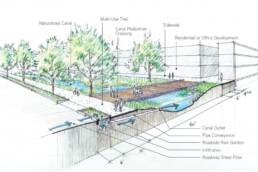
At the heart of the toolkit is a commitment to measurable ecological performance, moving beyond aesthetic “greening” to functional infrastructure. By shifting the focus from rapid conveyance (moving water away) to on-site infiltration(managing water where it falls), the guidelines establish best practices for bioretention planters, bioswales, and permeable streetscapes.
These systems are engineered to target the “first flush”—the initial inch of runoff that carries the highest concentration of urban pollutants, including hydrocarbons, heavy metals, and sediment.
Through a combination of physical filtration within engineered soil media and biological uptake by selected native vegetation, these LID features provide localized water quality treatment while significantly reducing the peak volume and velocity of stormwater entering the municipal sewer system.
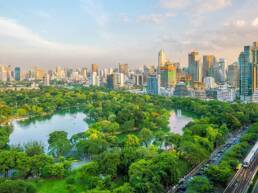
Furthermore, this section addresses the micro-climate benefits of decentralized LID. By maintaining soil moisture and increasing evapotranspiration, these “green” interventions provide critical cooling that mitigates the urban heat island effect
The toolkit is organized into five critical focus areas that move green infrastructure from isolated pilot projects into a standardized municipal operating procedure.
1. Policy & Planning This section reinforces the city’s vision by synthesizing existing goals from the 2040 Comprehensive Plan and Strategic Mobility Plan into a unified framework. Rather than creating new mandates, the toolkit serves as the essential bridge between high-level policy and physical implementation. It demonstrates exactly how to achieve adopted city-wide goals by translating abstract resilience targets into actionable, site-specific design strategies.
2. Partnerships & Community Support Successful implementation relies on stakeholder buy-in. This section outlines participatory design strategies and education initiatives to build public trust, ensuring that green interventions reflect the specific needs and identities of local neighborhoods.
3. Funding & Financing To ensure economic viability, the toolkit identifies diverse revenue streams—including federal grants, state-level environmental funds, and innovative public-private partnerships—to cover both upfront capital costs and long-term operations.
4. Maintenance & Stewardship Recognizing that green infrastructure is “living” infrastructure, this section provides an operational framework for long-term care. It addresses critical factors such as soil health, vegetation replacement, and the specialized training required for municipal crews.
5. Design & Engineering Standards This section serves as a strategic bridge to implementation by advocating for the adoption of established standard details. By referencing proven engineering specifications rather than creating redundant local protocols, the toolkit reduces institutional friction and provides a clear, approved path for contractors and developers. This standardized approach ensures that every project—from bioswales to stormwater bump-outs—delivers consistent, measurable gains in stormwater filtration and urban cooling while streamlining the municipal approval process.

The Green Streets Toolkit is more than a design manual; it is a policy-driven engine for urban transformation. It provides the technical clarity necessary to move green infrastructure from isolated pilot projects into the standard operating procedure for municipal development, ensuring long-term resilience is baked into the very fabric of the city.